

Jump to section
More reef tanks die to a $40 heater than to anything else in the cabinet. Not predation. Not the wrong salinity. Not a flooded sump. One component, failing in a way the owner couldn't see coming, cooking the tank or letting it freeze overnight. The fix isn't a better heater. The fix is not relying on one. This guide is about the design.
Heaters are the number-one tank killer
It isn't that heaters are badly built. It's that a heater is the one piece of equipment in a reef that runs flat out, every day, for years, with a single mechanical thermostat standing between off and destruction. Everything else in the cabinet degrades politely. Lights dim. Pumps slow. Skimmers stop pulling, and you notice over a week. A heater fails suddenly and completely, and the tank has hours left.
Which is why the goal isn't a heater that won't fail. Every heater fails eventually, whatever it cost. The goal is a system where one failing heater doesn't take the tank with it.
This is also the cheapest disaster to engineer away. Two smaller heaters and a $40 controller cost less than one decent fish, and doing it at build time is an order of magnitude cheaper than restocking a cooked tank.
The two ways a heater kills a reef
Both failure modes are common. They look different and they kill differently.
Stuck on. The thermostat's mechanical relay welds itself closed and the element runs continuously. Bulk Reef Supply's post-mortem on these failures puts numbers on it: a 300-watt heater stuck on in a 53 gal (200 L) tank can raise the temperature by 9 °F (5 °C) in a few hours. By morning you have a cooked tank, with fish dead, corals retracted and bleaching, and the bacterial colony killed off. It's the loudest failure and the most preventable one.
Stuck off. The thermostat fails open, the element burns out, or the seal cracks and the heater shorts to safety. The tank cools slowly, around a degree an hour on a small system, until the temperature is under 72 °F (22 °C) by morning. SPS corals go first and sensitive fish follow. Quieter, just as terminal, and especially common over a weekend away.
The asymmetry matters. A stuck-on heater overheats faster than a stuck-off heater cools. That is the entire argument for using two smaller heaters instead of one big one: when the worst happens, smaller wattage cooking the tank gives you more hours to notice.
Why heaters fail
Knowing how they die tells you what to buy and when to replace it. There are four common mechanisms, and they compound.
Most heaters under $50 switch with a bimetallic strip against a mechanical contact, and every on/off cycle throws a tiny spark across it. After a few hundred thousand cycles the contact pits, corrodes, and eventually welds itself shut. Better heaters like the Eheim Jäger and Cobalt NeoTherm use tougher contacts and last longer, but the wear is the same process at a slower rate.
Saltwater also leaves mineral scale on the element. Scale insulates, so the same wattage now runs hotter at the element than it used to, and on a glass-shrouded heater that heat eventually cracks the tube. Sometimes you find out because the GFCI trips. Sometimes you find out later.
Age does the rest. A submerged aquarium heater has a practical life of three to five years, and past year five you're on borrowed time even with a good brand. Replace them before they fail; it costs less than the alternative. Power surges shorten that clock further, since a single surge through the element can pit the thermostat contacts on its own. A GFCI outlet or a whole-house surge protector is cheap next to what it protects.
The two-heater playbook
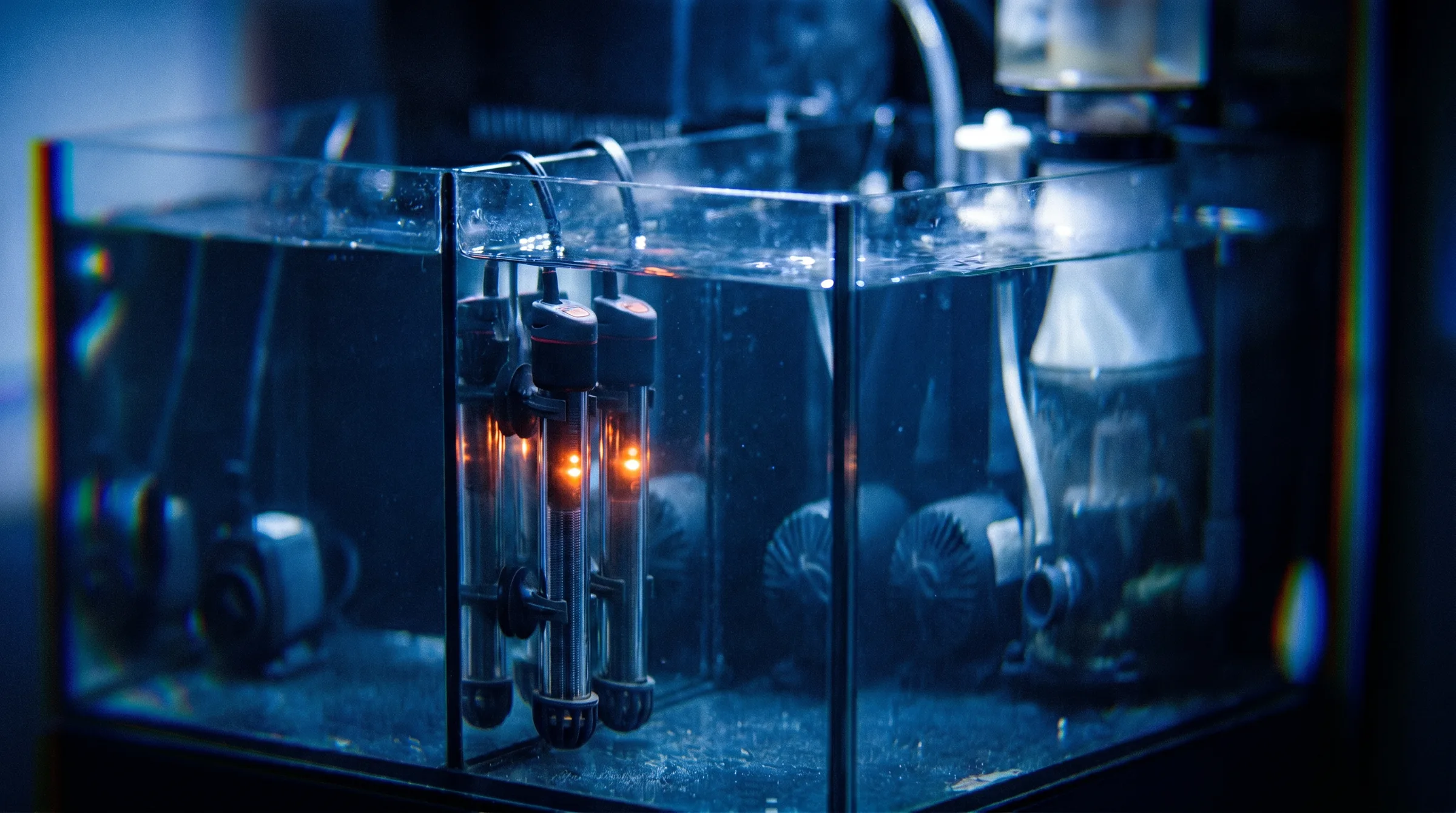
The setup that solves this is two heaters, each rated about half the wattage your tank needs. Not two big ones. Not one big and one small. Two equal, half-sized units.
A 53 gal (200 L) reef that asks for roughly 200 W of heating wants two 100 W heaters. A 106 gal (400 L) tank wants two 200 W. The arithmetic is boringly simple: one watt per litre, halved across two units.
The first benefit is the one that matters most. A 100 W heater stuck on doesn't have the power to cook a tank that size on its own; a 200 W heater stuck on does. Halving the wattage means the worst case is a tank that runs warm, not a tank that boils.
The second benefit is the failover. If one heater dies in the off position, the other is already in the water and at the same setpoint — it just runs more often until you swap the broken unit. A tank that would have crashed by morning simply runs slightly above duty cycle until you act. There is no urgent panic.
The third benefit is wear. Two heaters share the duty cycle: each turns on roughly half as often as a single big one would. Mechanical thermostats survive longer when they cycle less. Halving the load roughly doubles the expected lifespan.
Then pair them with a temperature controller. The heater's own thermostat is the first line of defence and the controller is the second. Even a $40 Inkbird ITC-308 does the job: when its own probe reads the tank above setpoint it cuts power to the outlet, whatever the heaters' internal thermostats happen to think. That's what redundancy actually means here. Two unrelated mechanisms have to fail before the tank is in danger.
Wiring through a temperature controller
The standard budget setup is two Eheim Jäger heaters and one Inkbird ITC-308 (or the WiFi-enabled 308Wi), and it wires up in two decisions.
Both heaters plug into the Inkbird's switched outlet, splitting it with a power strip if you need two sockets. The Inkbird sees a single load and doesn't know or care that two heaters are downstream. Set its probe to 78 °F (25.5 °C) with 0.3 °C of hysteresis, so the outlet powers on when the tank drifts below 25.2 °C and cuts once it climbs back above setpoint. That handles your day-to-day temperature.
Then set each heater's own dial 2–4 °F (1–2 °C) higher, say 81 °F (27 °C). Those dials are now failsafes rather than controls. If the Inkbird fails on, with a welded relay or a probe reading cold, the heaters stop themselves long before the tank cooks. If the Inkbird fails off, the heaters simply cycle on their own dials at the higher setpoint: the tank runs warmer than you'd like, but everything in it is alive when you notice.
That's the whole design. The controller's probe and the heaters' own thermostats are independent of each other, and both have to fail in the same direction on the same night for the tank to be in real trouble.
The gold standard: two heaters, two controllers
For a serious reef — full SPS, expensive livestock, a system you can't afford to lose to a single point of failure — the next step up is splitting the heaters across two independent controllers.
Plug one heater into the Inkbird and the second into an outlet controlled by your Apex (or Hydros, or GHL ProfiLux). Set the Apex outlet a little lower than the Inkbird, say 77 °F (25.0 °C) against 78 °F (25.5 °C). The Inkbird's heater is now the primary, and the Apex heater only wakes up if the tank actually cools below 25.0 °C.
The Apex (or any modern controller) adds two more layers on top: it monitors the tank temperature from a second, independent probe, and it alerts you via app push when readings drift outside your safe range. An overheating event you would have noticed in 4 hours becomes one you are paged about in 4 minutes.
Plug the Apex and the Inkbird into different wall outlets, ideally on different circuits. A tripped breaker or a kicked power strip then takes out one half of the system and leaves you with a working heater on a working controller. That's the whole point of the layout: any single thing can fail without the tank going with it.
Probe placement and the 5-year refresh
All of the above assumes the probe is reading the tank accurately, which comes down to where you put it.
Put the probe in the same body of water as the heaters. If the heaters live in the sump, the probe lives in the sump. Split them up and a failed return pump becomes a disaster: the display stops receiving heated water, the probe sitting in the display reports a cold tank, and the heaters obligingly cook the sump. The sump is usually the better heating zone anyway, since heaters there are easier to service, out of sight, and less likely to be knocked or cracked. Flow through a sump also tends to be stronger and steadier, which keeps the element clean and spreads the heat evenly.
Then replace them on a schedule instead of on failure. Mark the install year on each unit with a paint pen. At year five, or year three for budget brands, the odds of a thermostat failure climb sharply. A new heater is $40. A lost tank is everything. Keep a third heater of the same model boxed in the cabinet while you're at it, so a failure means a swap within 24 hours rather than whenever the next online order lands.
If you're not running a full controller, at least run an alarm. A $50 Wi-Fi temperature sensor from Govee or SensorPush will tell you when the tank goes out of range, and that one notification is usually the difference between noticing at 3 a.m. with the heater unplugged and a tank that survives, and noticing in the morning with half the livestock dead.
A practical shopping list
For a typical 53 gal (200 L) mid-budget reef, the redundant heating system looks like this:
- Two heaters, each ~100 W. Eheim Jäger 100W, Cobalt NeoTherm 100W, or BRS Titanium 100W are all proven three-to-five-year performers. Browse heaters →
- An external temperature controller. Inkbird ITC-308 ($40) is the budget standard; the WiFi version (308Wi, ~$60) adds remote monitoring and alerts. A Neptune Apex or Hydros Control X3 covers heating plus the rest of your tank's automation. Browse controllers →
- A spare third heater of the same model in a cabinet, ready to swap in.
- A separate temperature alert— at minimum, a Wi-Fi thermometer with push notifications, or use your controller's alert feature.
ReefPicker's build pre-flight nudges you when a build has one heater and no temperature controller. It's a note, not a blocker: a 13 gal (50 L) nano in a tight cabinet can reasonably run one controller-ready heater. From about 26 gal (100 L) upward, though, redundancy is the cheapest insurance you can buy.
Related reading
- How to Plan Your First Saltwater Aquarium — the full equipment list and stocking strategy for a beginner reef.
- Aquarium controllers — Inkbird, Hydros, Apex compared.
- Reef-safe heaters — what we stock and what we recommend.
- Apex vs GHL vs Mastertronic — the full controller landscape, beyond the single-parameter unit this guide covers.
- Pick fish that can live together — the Livestock Checker, filters, compat engine and pre-flight in one read.